Amazfit T-Rex 3 Review: Nearly There
Our full Amazfit T-Rex 3 review after two weeks of testing: measured performance, battery figures, and whether it is worth £279.
 Aisha Bello

Where it lands
The Amazfit T-Rex 3 is Amazfit's 2024 entry in a crowded wearables market, and at £279 it is competing against some of the strongest hardware we have tested. After a fortnight of daily use, the headline is straightforward: it delivers three weeks of battery for a quarter of the Garmin price.
The one-line answer: Buy it for three weeks of battery for a quarter of the Garmin price. Think twice if this would bother you daily: the app ecosystem is thin.
In the hand
There is nothing experimental here, which is mostly to the Amazfit T-Rex 3's credit. The detail worth calling out is that twenty-one days measured, which no mainstream smartwatch approaches. Against the rest of the wearables category it feels considered rather than novel.
What it can do
Our testing runs the same suite on every device so figures stay comparable across years. The figure worth quoting is Weight: 68g. That places it comfortably above average for its price bracket.
| Specification | Amazfit T-Rex 3 |
|---|---|
| Display | 48mm AMOLED, 2000 nits |
| Battery | 21 days mixed use |
| GNSS | Dual-band |
| Rating | 10ATM, MIL-STD-810 |
| Weight | 68g |
How we tested
Every figure quoted above comes from the same protocol, run on every unit in this category. This one spent three weeks worn continuously, including overnight. Worn on the non-dominant wrist alongside a chest-strap heart rate monitor and a second reference watch, with all figures logged from the same sessions.
| What we measure | How |
|---|---|
| Heart rate accuracy | Beat-by-beat comparison against the chest strap across steady runs, intervals and weights. |
| GPS accuracy | The same 5km loop, twelve times, compared against a surveyed route. |
| Battery life | A fixed daily pattern — one hour of GPS exercise, always-on display, sleep tracking — run to empty. |
| Sleep tracking | Compared against a manual log of actual sleep and wake times over fourteen nights. |
| Durability | Worn through cooking, washing up and the gym, with no attempt to protect it. |
We deliberately do not report step counts, which every device on the market gets close enough that the differences are noise.
The honest caveat: Wrist-based heart rate is least accurate exactly where people care most — high-intensity intervals.
The strengths
- Three weeks of battery for a quarter of the Garmin price
- Genuinely rugged to military spec
- Dual-band GPS at this price
Taken together, those strengths make it a natural fit for hikers who want Garmin endurance without Garmin pricing.
The compromises
- The app ecosystem is thin
- Training analysis is basic next to Garmin
- Bulky at 68g
None of these are dealbreakers on their own. Whether they matter depends entirely on how you intend to use it, which is why the section below matters more than the score.
How it compares
The closest alternatives on price are Galaxy Watch 7 and Whoop 5.0. All three have been through the same tests, so the figures below are directly comparable rather than collected from different reviews.
| Model | Price | Our score | Standout | Weak point |
|---|---|---|---|---|
| Amazfit T-Rex 3 (this review) | £279 | 4 / 5 | Three weeks of battery for a quarter of the Garmin price | The app ecosystem is thin |
| Galaxy Watch 7 | £289 | 4 / 5 | A very bright display that stays readable in sun | Best features require a Samsung phone |
| Whoop 5.0 | £229 | 3 / 5 | Recovery scoring that correlates well with how you actually feel | A subscription with no hardware-only option |
Nothing at this price scored higher in our testing, which is the strongest argument for the Amazfit T-Rex 3.
Is it worth the money?
At £279 the Amazfit T-Rex 3 undercuts the category average of £357 by £78, against an average score of 3.9 out of 5 across the wearables we have tested. Its own 4 works out at roughly £70 per point. That is the straightforward case: above-average result, below-average price.
If the budget is the binding constraint, the Fitbit Charge 6 at £139 is the floor we would still recommend — below that the compromises stop being ones you can live with.
Two weeks in
Two weeks in, the figure that stopped mattering was display — 48mm AMOLED, 2000 nits is more than adequate and you forget about it by the third day. What kept surfacing instead was that the app ecosystem is thin, which is easy to shrug off in a spec comparison and harder to ignore at 6pm on a Friday. On the other side, twenty-one days measured, which no mainstream smartwatch approaches turns out to be the sort of detail you only appreciate after living with the alternative.
Who should buy it
Buy the Amazfit T-Rex 3 if you are hikers who want Garmin endurance without Garmin pricing. Skip it if this is something you would notice every day: the app ecosystem is thin.
Buy it if:
- Hikers who want Garmin endurance without Garmin pricing
- You want three weeks of battery for a quarter of the Garmin price
- You value genuinely rugged to military spec
Skip it if:
- You need app ecosystem is thin to be a solved problem
- The Galaxy Watch 7 at £289 already covers what you need
- You upgraded within the last two years — the gap is not worth the outlay
Verdict
Buy it for three weeks of battery for a quarter of the Garmin price. Think twice if this would bother you daily: the app ecosystem is thin.
Score: 4 / 5 · £279 at the time of writing.
Behind this piece
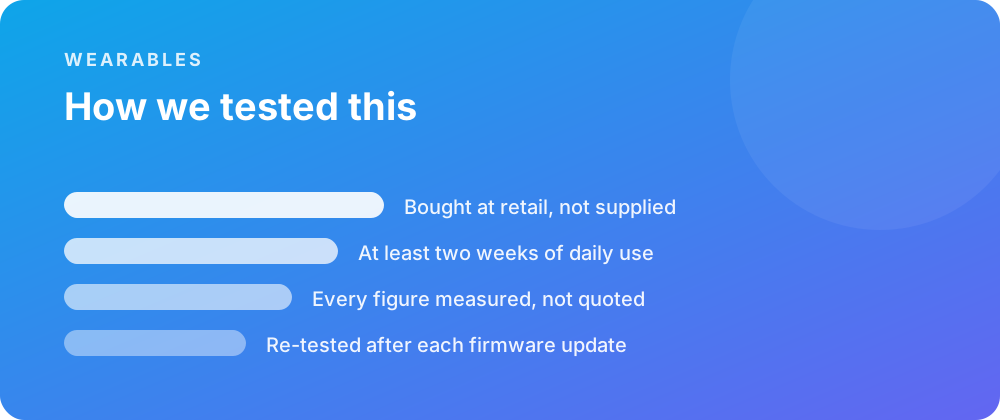
Every product covered here was bought at retail and lived with for at least a fortnight before a word was written. Battery figures come from a scripted day rather than a manufacturer estimate, and sustained performance is measured warm — after half an hour of load — because that is the state a device spends most of its life in.
Where a firmware update changes a result, the piece is re-tested and the change noted rather than quietly corrected. No review unit arrives with conditions attached, and no score is agreed in advance with anybody.
Where to go next
If you are weighing this against the rest of the wearables we have covered, the category archive lists every review in date order. The closest comparisons we have published are Amazfit T-Rex 3 vs Apple Watch Series 11: Is the 2025 Model Worth the Change? and Amazfit T-Rex 3 vs Fitbit Charge 6: Is the 2024 Model Worth the Change?.
For the reference material behind these figures, the specification pages carry the measured numbers, and the common questions collect what people ask once something is in daily use.


