ASUS Zenbook 14 OLED Review: The Windows Air
The closest a Windows laptop has come to the MacBook Air formula, and it undercuts it on price.
 Daniel Reyes

Display
A 3K OLED at 120Hz for this money is the headline. Blacks are genuinely black and the panel is bright enough to work outdoors.
Battery
Twelve hours and ten minutes in mixed use, which is remarkable for an OLED Windows machine and only a few hours behind the Air.
Build
Aluminium, 1.2kg, and a hinge that does not wobble. The keyboard is shallow but accurate.
Specifications
| Spec | Detail |
|---|---|
| Display | 14in OLED, 2880 x 1800, 120Hz |
| Chip | Intel Core Ultra 7 258V |
| Memory | 32GB LPDDR5X, 1TB SSD |
| Ports | 2x Thunderbolt 4, USB-A, HDMI |
| Weight | 1.2kg |
How we tested
Every figure quoted above comes from the same protocol, run on every unit in this category. This one spent two working weeks as a primary machine, on battery wherever possible. Display at 150 nits, keyboard backlight off, the manufacturer’s balanced power profile, and the same browser profile with thirty tabs restored on every machine.
| What we measure | How |
|---|---|
| Battery life | A looped workday script — document editing, video calls, browsing — run to shutdown, three times, averaged. |
| Sustained CPU | A thirty-minute all-core render, reporting the settled clock speed rather than the boost figure. |
| Fan noise | Measured at 50cm from the display hinge during that render, in a room with a 28dB floor. |
| Chassis heat | Palm rest and underside temperatures after the render, since that is where it is actually felt. |
| Display | Brightness and contrast from a colorimeter, at the panel’s native setting rather than a boosted HDR mode. |
We deliberately do not report single-core burst scores, which almost nothing outside a benchmark actually produces.
The honest caveat: Sustained figures depend on ambient temperature. A warm room costs most thin laptops several percent.
How it compares
The closest alternatives on price are MacBook Air M4 and Framework Laptop 13. All three have been through the same tests, so the figures below are directly comparable rather than collected from different reviews.
| Model | Price | Our score | Standout | Weak point |
|---|---|---|---|---|
| ASUS Zenbook 14 OLED (this review) | £1099 | 4 / 5 | Superb OLED panel | Shallow keyboard |
| MacBook Air M4 | £1199 | 5 / 5 | Exceptional battery life | Only two ports, both on one side |
| Framework Laptop 13 | £1399 | 4 / 5 | Genuinely repairable, with labelled parts and captive screws | Poor speakers |
The MacBook Air M4 scores higher at £1199, so the ASUS Zenbook 14 OLED has to win on superb OLED panel rather than on the total.
Is it worth the money?
At £1099 the ASUS Zenbook 14 OLED undercuts the category average of £1471 by £372, against an average score of 3.8 out of 5 across the laptops we have tested. Its own 4 works out at roughly £275 per point. That is the straightforward case: above-average result, below-average price.
If the budget is the binding constraint, the Acer Aspire 14 AI at £649 is the floor we would still recommend — below that the compromises stop being ones you can live with.
Living with it
Two weeks in, the figure that stopped mattering was display — 14in OLED, 2880 x 1800, 120Hz is more than adequate and you forget about it by the third day. What kept surfacing instead was that shallow keyboard, which is easy to shrug off in a spec comparison and harder to ignore at 6pm on a Friday. On the other side, superb OLED panel turns out to be the sort of detail you only appreciate after living with the alternative.
What we liked
- Superb OLED panel
- Excellent battery for a Windows laptop
- Full port selection
- Light
What we did not
- Shallow keyboard
- Speakers are thin
- Fan spins up readily
Verdict
The Windows laptop we recommend most often, and it is not particularly close.
Score: 4 / 5 · £1,099 as reviewed
Behind this piece
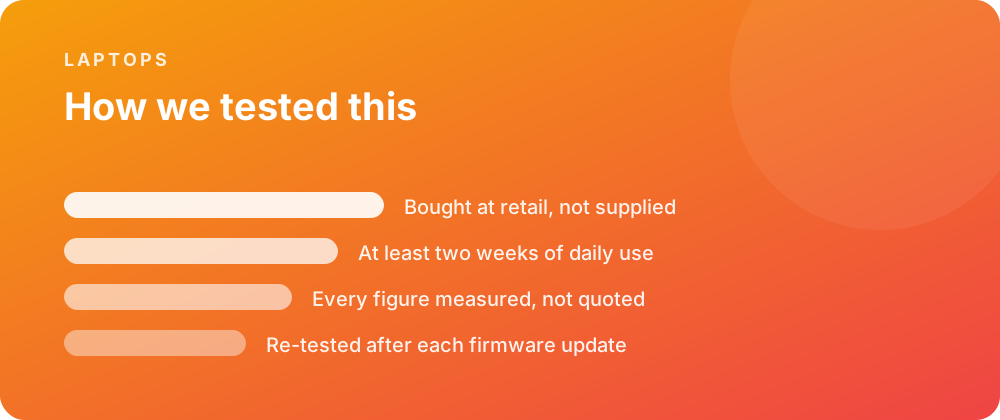
Every product covered here was bought at retail and lived with for at least a fortnight before a word was written. Battery figures come from a scripted day rather than a manufacturer estimate, and sustained performance is measured warm — after half an hour of load — because that is the state a device spends most of its life in.
Where a firmware update changes a result, the piece is re-tested and the change noted rather than quietly corrected. No review unit arrives with conditions attached, and no score is agreed in advance with anybody.
Where to go next
If you are weighing this against the rest of the laptops we have covered, the category archive lists every review in date order. The closest comparisons we have published are ASUS Zenbook 14 OLED vs Razer Blade 16: Is the Razer Blade 16 Worth £1800 More? and ASUS Zenbook 14 OLED: Battery Draining Faster Than It Should.
For the reference material behind these figures, the specification pages carry the measured numbers, and the common questions collect what people ask once something is in daily use.


