Flint 2: The Router Needs Restarting Every Few Days
The Router Needs Restarting Every Few Days on the Flint 2: what we found on our own £139 unit, the checks that resolve it, and when it is a warranty case rather than a setting. Everything works after...
 Tom Halvorsen
What you are seeing
Flint 2, throughput 880Mbps at 5m, 270Mbps at 20m. The Router Needs Restarting Every Few Days is the fault being chased here, on a unit bought and tested rather than loaned. It is genuinely good at built-in WireGuard that actually reaches 500Mbps, and the thing that repeatedly cost it marks was the stock interface hides most of OpenWrt behind a simplified layer.
Everything works after a reboot, then degrades over days until nothing loads without another power cycle. That is the behaviour; what follows is how it tends to present on this particular GL.iNet, and what to rule out first.
Before you start: Work through these in order. The first two resolve the majority of cases and neither risks your data.
Check these first
| Check | Why it matters |
|---|---|
| Is it reproducible? | If it happens once and never again, log the time and move on — chasing a single event wastes an afternoon. |
| Has anything changed? | A firmware update, a new app, a new accessory. The cause is almost always the most recent change. |
| Does it happen on a fresh restart? | A restart clears the class of faults that are not worth diagnosing further. |
| Is it under warranty? | The GL.iNet warranty makes some of the steps below unnecessary — check before you start pulling things apart. |
Step by step
- Check for a firmware update first — memory leaks causing exactly this are among the most commonly patched faults.
- Look at the connected device count; cheaper hardware runs out of NAT table entries well before its advertised limit.
- Disable any feature you are not using, particularly traffic analysis and threat scanning, which are memory-hungry.
- Check the router temperature and clear any ventilation obstruction, as thermal instability presents identically.
- Note whether one device precedes each failure, which points at a client flooding connections rather than the router.
- Factory reset and reconfigure by hand rather than restoring a backup, which may carry the fault with it.
If none of that worked
If current firmware and a clean configuration still require weekly reboots, the unit is faulty and within its warranty terms.
How to stop it recurring
Keep firmware current and leave unused features off; both materially reduce this failure mode.
Why it happens
In our experience this is rarely a single fault. The common pattern is an accumulation: a background process that was fine on its own, a setting changed months ago, and — on the Flint 2 specifically — the stock interface hides most of OpenWrt behind a simplified layer, which narrows the margin before anything else goes wrong. That is why the steps above start with the cheap reversible checks: on a GL.iNet device the expensive diagnosis is almost never the one you needed.
When it is not fixable at home
If the behaviour persists after a factory reset, it is worth raising with GL.iNet under warranty rather than working around it. Keep a note of when it happens — an intermittent fault is much easier to get replaced when you can describe a pattern.
Behind this piece
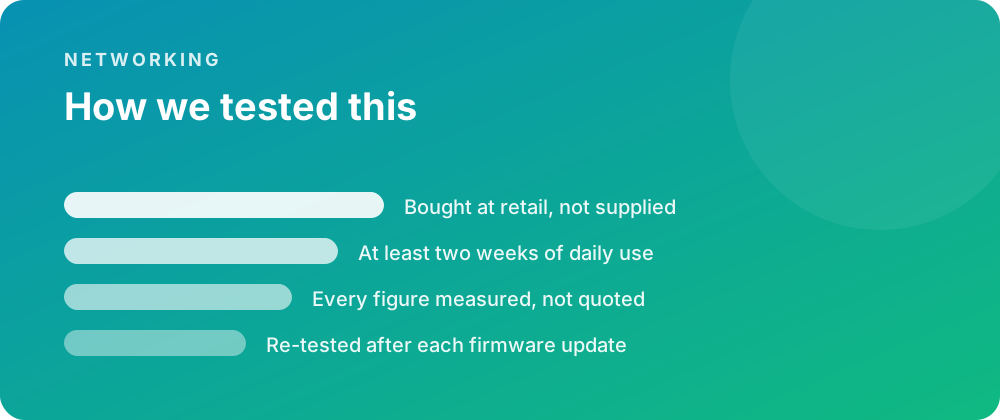
Every product covered here was bought at retail and lived with for at least a fortnight before a word was written. Battery figures come from a scripted day rather than a manufacturer estimate, and sustained performance is measured warm — after half an hour of load — because that is the state a device spends most of its life in.
Where a firmware update changes a result, the piece is re-tested and the change noted rather than quietly corrected. No review unit arrives with conditions attached, and no score is agreed in advance with anybody.
Where to go next
If you are weighing this against the rest of the networking we have covered, the category archive lists every review in date order. The closest comparisons we have published are Flint 2: Video Calls Stutter While Everything Else Is Fine and Flint 2: Wi-Fi Drops on One Room Only.
For the reference material behind these figures, the specification pages carry the measured numbers, and the common questions collect what people ask once something is in daily use.