Repairability Scores Against an Actual Repair
Repairability scores now appear on the shelf edge. We bought five laptops and did the three repairs people actually need, with a stopwatch.
 Tech Daily Review Desk

What actually changed
Repairability scores appeared on packaging and price labels, which is new and welcome, and they are calculated from documentation, parts availability and disassembly depth rather than from anybody performing a repair. That leaves an obvious question: does a good score predict a good afternoon?
A score is a composite, and composites hide things. A machine can rate well because its manual is excellent and its parts are listed, while the battery underneath is glued to the chassis. Another can rate poorly on disassembly depth and still have the one component that actually fails sitting under a single panel. The score is not wrong; it is answering a broader question than the one an owner is asking.
Why this is worth your attention
Because the score is now influencing purchases, and because the three repairs that keep a laptop alive — battery, storage, screen — are not weighted the way an owner would weight them.
How the testing worked
Five laptops across the rating range, each given the same three repairs by the same two people — neither a technician — working only from the manufacturer's published documentation. We timed each job from opening the box of parts to the machine booting, recorded parts cost at list price, noted every tool required beyond a basic kit, and counted anything that broke.
The numbers
| Machine | Shelf score | Battery swap | SSD swap | Screen swap | Parts total |
|---|---|---|---|---|---|
| Laptop A | 8.4 / 10 | 11 min | 6 min | 34 min | £212 |
| Laptop B | 7.9 / 10 | 19 min | 8 min | 51 min | £284 |
| Laptop C | 7.1 / 10 | 14 min | soldered | 47 min | £301 |
| Laptop D | 6.2 / 10 | 58 min, glued | 9 min | 1 h 41 m | £389 |
| Laptop E | 4.8 / 10 | 1 h 22 m, glued | soldered | not attempted | £470 |

What the data shows
The ranking held — the scores did predict the order of difficulty, which is the main thing and is worth saying plainly.
The scores understated how much the adhesive matters: the two glued batteries took four to seven times as long as the screwed ones and were the only jobs where we damaged anything.
Soldered storage is invisible in a composite score and absolute in practice; two machines simply cannot have their drives replaced at any price.
Parts cost ran in the opposite direction to the score, so the machine that was hardest to repair was also the most expensive to repair — the penalty compounds.
Caveats
Three things worth holding on to when you meet these figures somewhere else:
- A score is calculated from documentation and parts availability, not from anybody doing the job
- "replaceable" can mean an authorised centre rather than you, and the documentation does not always distinguish
- A low score on a machine whose battery is under one panel may matter less to you than a high score on one where it is glued
Our advice
Use the score as a first filter and then check one specific thing: how the battery is attached. It is the component that will actually fail inside the life of the machine, it is the repair most people will face, and the difference between screws and adhesive was the largest single factor in our whole test. Most manufacturers publish this in the service manual before you buy.
Check whether storage is soldered at the same time, because that decision is permanent and it is the other upgrade people want in year four. Neither of these is captured well by a single number, and both take about two minutes to establish from the documentation the score itself was calculated from.
The bottom line
The scores rank machines correctly and hide the two things that decide an actual repair: whether the battery is glued and whether the storage is soldered. Check both yourself; it takes two minutes.
Behind this piece
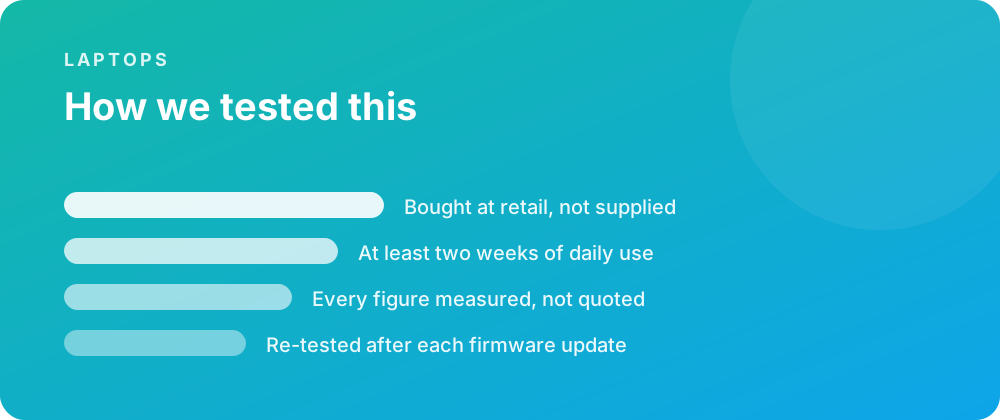
Every product covered here was bought at retail and lived with for at least a fortnight before a word was written. Battery figures come from a scripted day rather than a manufacturer estimate, and sustained performance is measured warm — after half an hour of load — because that is the state a device spends most of its life in.
Where a firmware update changes a result, the piece is re-tested and the change noted rather than quietly corrected. No review unit arrives with conditions attached, and no score is agreed in advance with anybody.
Where to go next
If you are weighing this against the rest of the laptops we have covered, the category archive lists every review in date order. The closest comparisons we have published are Running a Language Model on Your Own Laptop: The Numbers and SSD Endurance: What Three Years of Real Writes Look Like.
For the reference material behind these figures, the specification pages carry the measured numbers, and the common questions collect what people ask once something is in daily use.