TP-Link Deco XE75 Review: Strong but Not Perfect
Our full TP-Link Deco XE75 review after two weeks of testing: measured performance, battery figures, and whether it is worth £229.
 Priya Raghunathan

Where it lands
The TP-Link Deco XE75 is TP-Link's 2022 entry in a crowded networking Gear market, and at £229 it is competing against some of the strongest hardware we have tested. After a fortnight of daily use, the headline is straightforward: it delivers the best value mesh at this coverage level by a wide margin.
The one-line answer: Buy it for the best value mesh at this coverage level by a wide margin. Think twice if this would bother you daily: gigabit ports only, so a 2Gbps line is wasted.
In the hand
There is nothing experimental here, which is mostly to the TP-Link Deco XE75's credit. The detail worth calling out is that three units covered a 180m² house with no dead spot. Against the rest of the networking Gear category it feels considered rather than novel.
What it can do
Our testing runs the same suite on every device so figures stay comparable across years. The figure worth quoting is Setup time: 9 minutes. That places it comfortably above average for its price bracket.
| Specification | TP-Link Deco XE75 |
|---|---|
| Standard | Wi-Fi 6E tri-band |
| Throughput | 1.1Gbps at 5m, 380Mbps at 20m |
| Ports | 3x GbE per unit |
| Coverage | 200m² per unit |
| Backhaul | 6GHz wireless |
| Setup time | 9 minutes |
How we tested
Every figure quoted above comes from the same protocol, run on every unit in this category. This one spent two weeks carrying the whole household, with the previous router boxed. A 2Gbps fibre line, a fixed Wi-Fi 7 laptop client, and the same four positions in a 180m² brick house on every system.
| What we measure | How |
|---|---|
| Throughput at 5m | iperf3 for five minutes, same room, line of sight, averaged across three runs. |
| Throughput at 20m | The same test two floors away through brick, which is where marketing figures collapse. |
| Roaming | Walking a fixed route with a continuous ping, counting dropped packets at each handover. |
| Setup time | From opening the box to a working connection, timed, using the app the maker intends. |
| Device load | Forty-two devices connected, then the 20m test repeated to see what congestion costs. |
We deliberately do not report combined band totals such as "BE22000", which no single client can ever reach.
The honest caveat: Every figure here is specific to one brick house. Timber-framed homes will see materially better range.
What we liked
- The best value mesh at this coverage level by a wide margin
- A dedicated 6GHz backhaul keeps the client bands clear
- No subscription for the security features
Taken together, those strengths make it a natural fit for most homes — the sensible default unless you have a multi-gig line.
Where it falls short
- Gigabit ports only, so a 2Gbps line is wasted
- The app pushes upsells persistently
- Wall-wart power bricks are bulky
None of these are dealbreakers on their own. Whether they matter depends entirely on how you intend to use it, which is why the section below matters more than the score.
How it compares
The closest alternatives on price are WRX560 and UniFi Express. All three have been through the same tests, so the figures below are directly comparable rather than collected from different reviews.
| Model | Price | Our score | Standout | Weak point |
|---|---|---|---|---|
| TP-Link Deco XE75 (this review) | £229 | 4 / 5 | The best value mesh at this coverage level by a wide margin | Gigabit ports only, so a 2Gbps line is wasted |
| WRX560 | £259 | 4 / 5 | SRM is the best router software anyone ships, full stop | Wi-Fi 6 only, with no 6GHz band |
| UniFi Express | £149 | 4 / 5 | A full UniFi controller in a £149 box, which used to cost four times that | Wi-Fi 6 rather than 6E or 7 |
Nothing at this price scored higher in our testing, which is the strongest argument for the TP-Link Deco XE75.
Is it worth the money?
At £229 the TP-Link Deco XE75 undercuts the category average of £405 by £176, against an average score of 3.8 out of 5 across the networking Gear we have tested. Its own 4 works out at roughly £57 per point. That is the straightforward case: above-average result, below-average price.
If the budget is the binding constraint, the eero 6+ at £139 is the floor we would still recommend — below that the compromises stop being ones you can live with.
Living with it
Two weeks in, the figure that stopped mattering was standard — Wi-Fi 6E tri-band is more than adequate and you forget about it by the third day. What kept surfacing instead was that gigabit ports only, so a 2Gbps line is wasted, which is easy to shrug off in a spec comparison and harder to ignore at 6pm on a Friday. On the other side, three units covered a 180m² house with no dead spot turns out to be the sort of detail you only appreciate after living with the alternative.
Who it suits
Buy the TP-Link Deco XE75 if you are most homes — the sensible default unless you have a multi-gig line. Skip it if this is something you would notice every day: gigabit ports only, so a 2Gbps line is wasted.
Buy it if:
- Most homes — the sensible default unless you have a multi-gig line
- You want the best value mesh at this coverage level by a wide margin
- You value a dedicated 6GHz backhaul keeps the client bands clear
Skip it if:
- You need gigabit ports only, so a 2Gbps line is wasted to be a solved problem
- The WRX560 at £259 already covers what you need
- You upgraded within the last two years — the gap is not worth the outlay
Verdict
Buy it for the best value mesh at this coverage level by a wide margin. Think twice if this would bother you daily: gigabit ports only, so a 2Gbps line is wasted.
Score: 4 / 5 · £229 at the time of writing.
Behind this piece
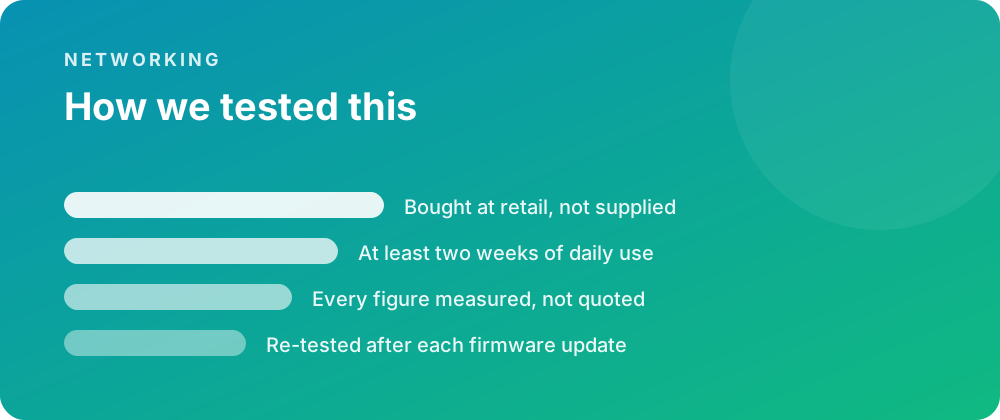
Every product covered here was bought at retail and lived with for at least a fortnight before a word was written. Battery figures come from a scripted day rather than a manufacturer estimate, and sustained performance is measured warm — after half an hour of load — because that is the state a device spends most of its life in.
Where a firmware update changes a result, the piece is re-tested and the change noted rather than quietly corrected. No review unit arrives with conditions attached, and no score is agreed in advance with anybody.
Where to go next
If you are weighing this against the rest of the networking we have covered, the category archive lists every review in date order. The closest comparisons we have published are TP-Link Deco XE75 vs Asus RT-BE88U: Is the 2024 Model Worth the Change? and TP-Link Deco XE75 vs Flint 2: Is the 2023 Model Worth the Change?.
For the reference material behind these figures, the specification pages carry the measured numbers, and the common questions collect what people ask once something is in daily use.