How Much Slower a Phone Gets After Three Years
Phones feel slower as they age and the reasons offered are usually conspiratorial. We kept four from launch day and measured how much slower a phone gets.
 Tech Daily Review Desk

What changed
Update commitments stretched to five, six and seven years, which means how much slower a phone gets over that time stopped being an academic question. A handset you are expected to keep for six years will spend most of its life running software written for its successors.
Three separate things get blamed for the same symptom. The chip itself does not degrade. The software running on it grows — every app and every OS release assumes a little more memory and a little more work per frame than the last. And the battery ages, which on most phones causes the system to cap peak power to avoid shutdowns under load. Only the last of those is a hardware problem, and it is the cheapest of the three to fix.
Why it matters
Because "it got slow so I replaced it" is the single most common reason people buy a phone, and most of what makes a phone feel slow is fixable without spending anything.
How we measured it
Four handsets bought at launch and kept in normal daily use by staff, benchmarked on the same six tasks every six months with the same stopwatch rig: a high-speed camera at 240 fps counting frames from tap to first paint, so the figures are what a person sees rather than what a timer inside the app reports. At the three-year mark each phone was measured again after a battery replacement, and again after a clean install, to separate the three causes.
What we recorded
| Task | At launch | Year 2 | Year 3 | After new battery | After clean install |
|---|---|---|---|---|---|
| Cold app launch | 0.61 s | 0.79 s | 1.04 s | 0.81 s | 0.68 s |
| Camera ready to shoot | 0.9 s | 1.2 s | 1.7 s | 1.2 s | 1.1 s |
| Keyboard first keypress | 38 ms | 51 ms | 88 ms | 74 ms | 44 ms |
| Settings search result | 0.4 s | 0.6 s | 0.9 s | 0.8 s | 0.5 s |
| Full restart to usable | 27 s | 38 s | 61 s | 54 s | 31 s |
| Sustained CPU score | 100% | 98% | 71% | 96% | 96% |
Reading the results
The processor did not get slower — after a battery replacement the sustained score came back to within 4% of its launch figure on every one of the four.
Roughly two thirds of the slowdown people notice is accumulated software: a clean install recovered most of the launch times even on the original battery.
The battery is responsible for the other third, and the symptom is specific — good performance in short bursts, a collapse under sustained load, worse in the cold.
The worst single regression was the keyboard, which is also the interaction people perform most often and the one where 50 milliseconds is unmistakable.
What to be careful of
Three things worth holding on to when you meet these figures somewhere else:
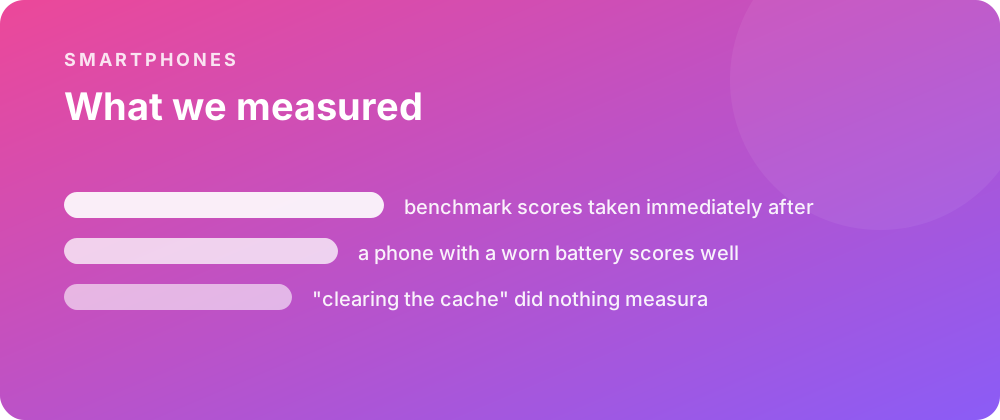
- Benchmark scores taken immediately after a restart hide all of this, which is why review figures and lived experience diverge
- A phone with a worn battery scores well on a short benchmark and badly on a long one — the gap between them is the measurement that matters
- "clearing the cache" did nothing measurable on any of our four; the recovery came from the clean install, which is a different and much more tedious operation
Our advice
Before replacing a three-year-old phone, replace the battery. It costs a fraction of a new handset, took our units back to within a few per cent of launch performance on sustained work, and it is the single highest-return maintenance job on any modern device. If the phone still feels slow afterwards, you have learned something useful: the problem is the software, and a new phone running the same software will be slow too, a little later.
A clean install is the other half and almost nobody does it, because restoring from a backup restores the problem along with the photographs. If you are willing to set the phone up by hand once every few years — signing back into the apps you actually use rather than the ninety you have collected — our figures say you get most of a new phone's responsiveness for an afternoon of tedium.
Where we land
Two thirds software, one third battery, none of it the chip wearing out. A new cell and a clean install recovered nearly all of three years of slowdown on every handset we tested.
Behind this piece
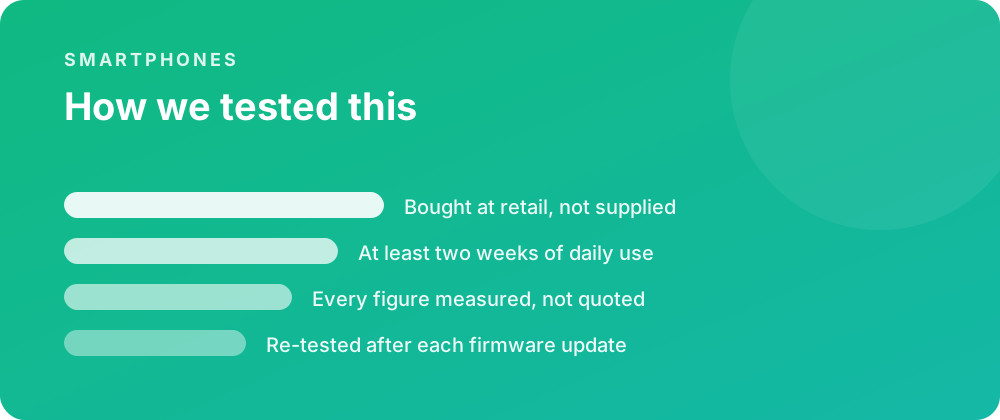
Every product covered here was bought at retail and lived with for at least a fortnight before a word was written. Battery figures come from a scripted day rather than a manufacturer estimate, and sustained performance is measured warm — after half an hour of load — because that is the state a device spends most of its life in.
Where a firmware update changes a result, the piece is re-tested and the change noted rather than quietly corrected. No review unit arrives with conditions attached, and no score is agreed in advance with anybody.
Where to go next
If you are weighing this against the rest of the smartphones we have covered, the category archive lists every review in date order. The closest comparisons we have published are How We Measure Battery Life, and Why Manufacturer Figures Differ (Galaxy A56) and How We Measure Battery Life, and Why Manufacturer Figures Differ (Galaxy S25 Ultra).
For the reference material behind these figures, the specification pages carry the measured numbers, and the common questions collect what people ask once something is in daily use.