Wireless Charging: Where the Missing Watts Go
A pad that says 15 W does not put 15 W in the battery. We metered the wall socket and the cell at the same time and measured everything that went missing in between.
 Tech Daily Review Desk

What actually changed
Magnetic alignment turned wireless charging from a novelty into something people use nightly, and the advertised figures climbed with it. The efficiency figures did not climb nearly as fast, and almost nobody publishes them.
Induction loses energy at every step: in the pad's own conversion, in the coupling between two coils that are never perfectly aligned, and in the phone's rectifier. A cable skips all three. The losses are also not constant — a slightly offset coil does not charge a bit slower, it charges a lot slower and gets a lot hotter, because the energy that misses the receiver has to go somewhere.
What is at stake
Because the energy that does not reach the battery leaves as heat, in contact with the battery, which is the condition batteries age fastest under. The inefficiency is not only a cost on the bill; it is a cost on the cell.
How the testing worked
A mains meter at the socket and a coulomb counter on the battery side, charging the same phone from 20% to 80% by each method, room held at 21°C, case removed, nothing else running. Temperature was read with a thermal camera at the hottest point of the phone's back, not at the pad. The misaligned row is the pad offset by 8 mm, which is roughly what you get putting a phone down in the dark.
The numbers
| Method | Drawn at the wall | Into the battery | Lost | Time | Peak temperature |
|---|---|---|---|---|---|
| USB-C cable, 30 W | 26.4 Wh | 21.1 Wh | 20% | 31 min | 34°C |
| Magnetic pad, 15 W | 31.8 Wh | 20.9 Wh | 34% | 52 min | 41°C |
| Flat pad, 7.5 W | 36.9 Wh | 20.8 Wh | 44% | 1 h 48 min | 43°C |
| Flat pad, 8 mm off centre | 48.2 Wh | 20.6 Wh | 57% | 3 h 06 min | 47°C |
| Magnetic pad in a 3 mm case | 34.1 Wh | 20.9 Wh | 39% | 1 h 04 min | 44°C |

Reading the results
Even at its best, wireless charging used about a fifth more energy than the cable, and a badly placed phone used nearly double.
Magnetic alignment is the single biggest variable in the whole test — it is worth more than the wattage on the box.
Every wireless method ran the battery hotter than the cable did, and the offset case reached a temperature we would not want a phone sitting at all night.
A thick case does not stop it working, it makes it worse: the same charge took twice as long and ran 3°C hotter.
What to be careful of
Three things worth holding on to when you meet these figures somewhere else:
- The wattage on a pad is what the pad can offer, not what your phone will accept from it
- Overnight charging on a pad means hours at temperature after the battery is full, which is the worst of the two things that age a cell
- A pad that stays warm with no phone on it is drawing power to look for one — ours cost 0.9 W doing nothing at all
What we would buy
Use a pad for convenience during the day — putting the phone down on a desk and picking it up charged is genuinely pleasant, and topping up from 60% to 80% over an hour is a mild use of it. Use a cable overnight and when you are in a hurry. That split gets you the convenience where it is worth having and avoids the two situations where the inefficiency turns into heat against the battery.
If you do charge on a pad, buy a magnetic one and take the phone out of a thick case. Alignment was worth more in our measurements than any difference between brands or advertised wattages, and it is the one variable entirely within your control. The cheapest magnetic pad we tested beat the most expensive flat one on every figure in the table.
Our verdict
Convenient and consistently wasteful: a fifth more energy at best, nearly double at worst, and always hotter against the cell. Worth it during the day, not worth it all night.
Behind this piece
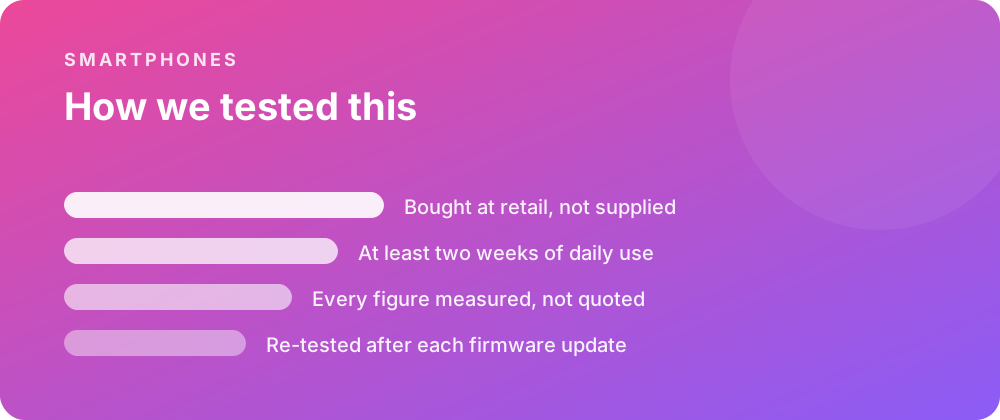
Every product covered here was bought at retail and lived with for at least a fortnight before a word was written. Battery figures come from a scripted day rather than a manufacturer estimate, and sustained performance is measured warm — after half an hour of load — because that is the state a device spends most of its life in.
Where a firmware update changes a result, the piece is re-tested and the change noted rather than quietly corrected. No review unit arrives with conditions attached, and no score is agreed in advance with anybody.
Where to go next
If you are weighing this against the rest of the smartphones we have covered, the category archive lists every review in date order. The closest comparisons we have published are Xiaomi 15 Ultra Review: A Camera With a Phone Attached and Xiaomi 15 Ultra Review: Strong but Not Perfect.
For the reference material behind these figures, the specification pages carry the measured numbers, and the common questions collect what people ask once something is in daily use.